
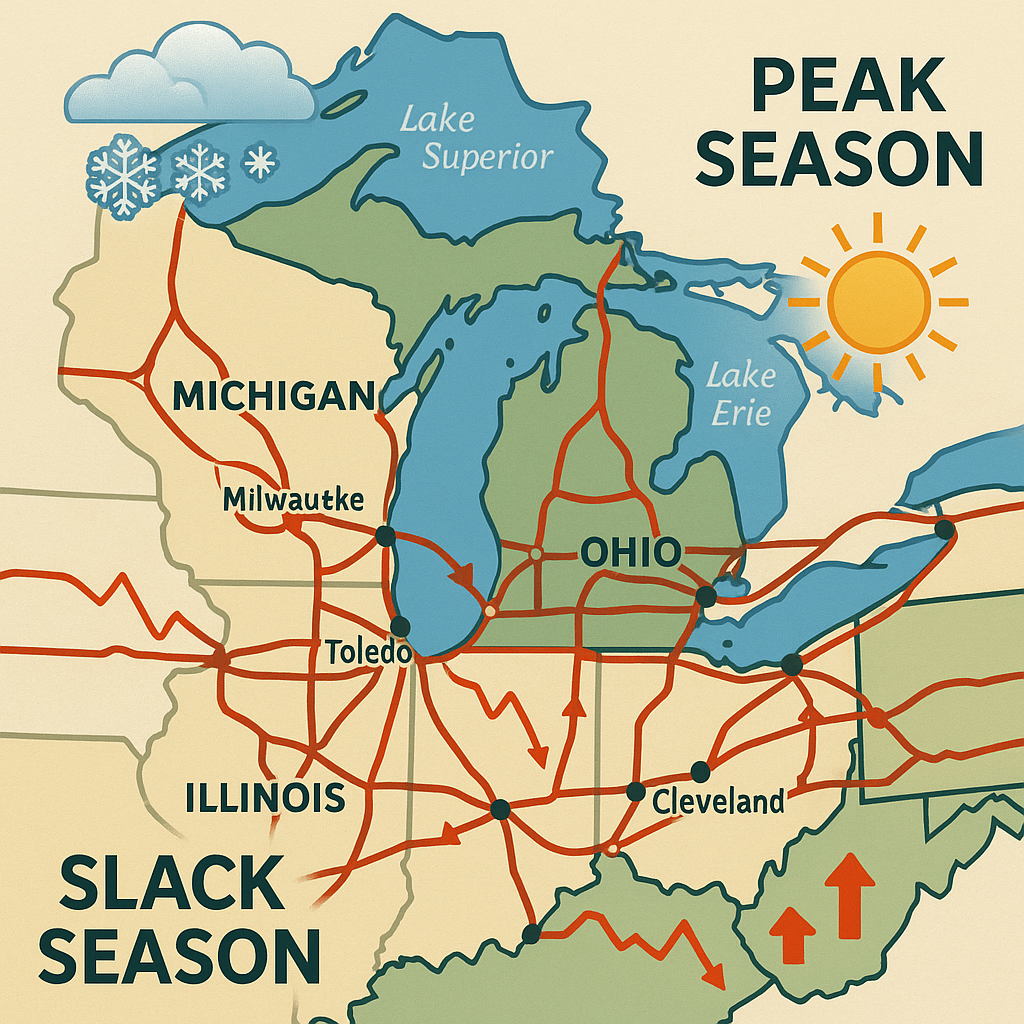
Overseeing Great Lakes freight in the states of Michigan, Ohio, Wisconsin, and Illinois is like being a captain of an ever-changing ship riding the high waves of storms and poor weather, the uncontrolled surge of holiday freight, and sudden shifts in the economy. Both shippers and carriers have now made seasonal dry van tracking a must-have strategic move and no longer a backup planning tool. The combination of dynamic changes, such as weather forecasts, and robust tactics like demand adaptation strategies, such as load forecasting and heatmap analytics, but also water transportation can level out the freight peaks and valleys, protect the profits, and make customers happy all year long.
Freight Seasonality in the Great Lakes Waters
On one side of the scales is the harsh winter bite from Lake Superior’s winds and, on the other side, the intolerable midsummer dryness wrapping the shores of Lake Erie. The traffic corridors of the Great Lakes region bear the brunt of such extreme weather from anywhere in North America. These climate conditions are responsible for two extreme transport modes:
- Peak Season (April–June, September–November):
- Farmers moving planting equipment and harvesting
- Holiday Merchandise shipments ramping up cardiovascular exercise (holiday spikes)
- Construction materials flowing in during warmer months
- Farmers moving planting equipment and harvesting
- Slack Season (January–March, July–August):
- Lower agricultural production
- Tourist traffic jams on the main roads
- Factory Maintenance Shutdowns
- Lower agricultural production
If carriers lack accurate demand planning, they face the risk of carrying empty miles in slack months and forego the chance to increase revenues in busy windows. A trustworthy seasonal dry van tracking chart displays the timing of the trailers being loaded, the location of blockages that are forming, and the resources that should be allocated for maximum output.

The Core Problems and the Issues at Hand
- Erratic Weather Conditions
Blizzards, ice storms, and sudden lake effect snow may close some routes or slow traffic to a crawl. If the company is not aware of the temperature and precipitation changes in real time, there can be idle shipments when the margins are eroded. - Holiday Spikes & Marketing Shift
Chicago and Cleveland retailers begin their holiday marketing season as early as September, creating an overlap between the beginning of school season and the end of year surges. Dry van capacity must be able to flex rapidly or risk turning freight away. - Driver Availability and Rehiring
During the slack season, some drivers take time off or work additional jobs. When surge capacity is called for again, the carriers dash about to rehire and retrain the employees, which is an expensive and lengthy process. - Data Silo and Manual Tracking
A lot of the transportation management systems (TMS) don’t have integrated dashboards, leading to dispatchers juggling spreadsheets, phone check-ins, and at times, unsteady GPS feeds. This makes it difficult to make load forecasting and hampers the decisions of resource allocation.
Strategies for Demand Adaptation
A forward-thinking view on seasonal dry van tracking stands at the intersection of people, process, and technology. Here are some ways to plan:
- Conjoined Load Forecasting
Make use of past shipment information and predictive analytics so that you can know the volume will be changing weeks before. Introducing elements like commodities prices and customer order trends will make your learning more precise. - Fluid Resource Allocation
Instead of being fixed with fleet sizes adopt a lean workforce and a pool of part-time drivers who are flexible. This allows you to gear up your capacity for peak season and bring it down when the routes are quiet. - Surge Capacity Partnerships
Nurture ties with third party carriers and freight places. These partners can step in, thus preventing the loss of revenue by utilizing them in a condition of scarce capacity. - Traffic Hotspot Visualization via Heatmap Analytics
Place a geographic heatmap analytics dashboard to see the flows from destination to origin. The heat spots signal by extended dwell times where you should consider re-routing trucks or expanding your yard. - Automate Alerting for Holiday Spikes
Set your TMS to automate staff and equipment checks when certain key holiday figures are reached — like an order increase of 20% or more for Black Friday or Memorial Weekend. - Shift Scheduling Depending on Weather
Use real-time meteorological data to direct the route planning processes. If a heavy snowfront pushes toward Detroit, change the schedule earlier, pre-pose the trailers, or route the truck to avoid delays. - Rehiring and Retention Programs
In order to keep constantly avoiding the churn, seasonal bonuses, and cross-training are very good options to offer to drivers. Drivers will prefer the opportunity to earn bonuses during peak season and flexible downtime in slack season.

Seasonal Demand Comparison
| Season | Characteristics | Key Adaptation Actions |
| Peak | – High volume & holiday spikes– Tight capacity– Elevated freight rates | – Lock in driver contracts early– Pre-book surge capacity– Intensify load forecasting accuracy |
| Slack | – Lower shipment counts– Driver downtime– Reduced spot market rates | – Implement maintenance windows– Offer driver cross‑training– Scale down equipment leases |
The Role of Technology in Tracking
The modern TMS platforms are the brain hub for demand adaptation. The indispensable features you should look for include:
- Real‑Time Visibility: Track trailer location, door sensors, and temperature readings in one unified view.
- Predictive ETA Algorithms: Use machine learning to refine load forecasting, learning from past delays and driver behaviors.
- Cloud‑Based Collaboration: Ensure shippers, carriers, and brokers share a single source of truth, avoiding costly miscommunications.
- APIs for Third‑Party Integrations: Plug in weather feeds, fuel‑pricing services, and labor management systems to enrich data without rebuilding from scratch.
An instance could be a carrier such as HMD Trucking https://www.hmdtrucking.com/truck-driving-jobs/dry-van-lease-purchase-atlanta/ which might incorporate satellite-weather alerts right in their dispatch console, which will, in turn, allow them to preemptively reroute loads off the I‑75 corridor whenever lake effect snow is warned.
Human Factors and Organizational Readiness
Only the technology alone cannot eliminate the seasonal volatility. Companies need to do:
- Delegate Responsibility to Dispatchers for Problem Solving
Making sure the dispatch teams get the training to solve the problems and get the most efficient out of the operation, is what you should be looking for. - Cross Functional Demand Planning
Every department needs to work hand in hand, such as sales, marketing, operations, and finance. They should look at the sales forecasts, customer promotions, and maintenance schedules regularly to align everyone on seasonal objectives. - Continual Improvement Cycles
It is important to hold a debrief after each busy season. Where did the delays occur frequently? What were the weather conditions that affected the most? Use those findings for the planning of the next year. - Scalable Hiring Practices
Expand the driver pool by establishing long-term relations with local CDL schools and advertising referral bonuses. Uphold a good public image with seasonal employees to create a pool of qualified drivers.
KPI to Measure Success
To determine how effective your implementation of demand adaptation is, you can track the following:
- On‑Time Delivery Rate during holiday spikes
- Empty Mile Percentage through peak season vs. slack season
- Driver Turnover Rate for seasonal staff
- Revenue per Available Trailer Hour
- Forecast Accuracy: variance between predicted and actual monthly load counts
An upturn in on-time performance, along with better relationships with flexible drivers, shows that your measures for seasonality have been successful.
Future Perspectives: What Will Change in the Great Lakes Freight
- The Electrification of Last-Mile Delivery Vans
The electrification of delivery vans will be getting deeper into the game. Carriers will be required to take into account the charging schedules of their vans and the ones affected by the harsh weather. - More IOT Sensors in Use
Besides furnishing their location, the sensors will be giving more detailed information about door opening, vibration, and weight distribution. The data will be utilized for advanced heatmap analytics which will, in turn, highlight inefficiencies. - Artificial Intelligence Based Procurement Signals
Soon enough, artificial intelligence will be achieving the impossible by gleaning the hottest social trends, port congestion levels, and macroeconomic data to perfect load forecasting beyond any human capability. - Shared: the Freight Network
Bus capacity models will be used more, allowing both the small and mid-sized carriers to share benefits in the period of slack and peak together.
Final Remark
In the unpredictable environment of the Great Lakes region, the mastery of seasonal dry van tracking and demand adaptation is no longer an option, but a necessity. By combining high-tech solutions ― like heatmap analytics and direct meteorological feeds ― with the humans’ rigorous processes of demand planning, resource allocation, and rehiring, freight carriers can flourish through any seasonal holiday surge, winter storms, and summer lulls. With the right mindset and tools at hand, not only will you navigate through the ups and downs of seasonal traffic in the Great Lakes freight but also turn it into a competitive advantage that will lead to profitability and customer loyalty throughout the whole year.